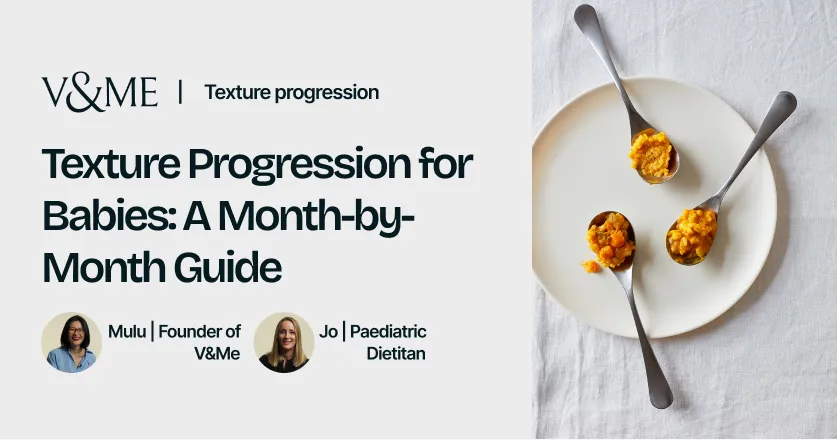
By Jo Lenz, Registered Dietitian (HCPC registered), in conversation with Mulu, founder of V&Me · Published July 2026
Texture progression means gradually moving your baby from smooth foods towards the family meals they should be eating by around 12 months. There are no hard and fast rules, and every baby is different, but there is one thing the evidence is clear on: if textured foods are delayed beyond around 9 to 10 months, children can go on to have more feeding difficulties as they get older. This guide sets out what a reasonable path looks like, month by month, based on a conversation between V&Me founder Mulu and Jo Lenz, the registered dietitian who has worked with V&Me from the start.
If you have ever stood in the kitchen wondering whether your baby should be on smooth, mashed, lumpy or finger foods, you are not alone. As Mulu put it in our conversation, the only guidance most parents ever see is the age printed on a pouch. Jo agrees the confusion is real: there is very little out there on textures, and the stage pictures you find online can sometimes increase anxiety rather than reduce it, because they make parents worry their baby is behind. So treat what follows as a helpful map, not a test your baby has to pass.
Why texture progression matters
The goal is simple. By 12 months, the ideal is for your baby to be accepting family foods. That means normal meals, adapted to be low in salt and sugar, eaten alongside the rest of you. Everything between 6 and 12 months is about getting there gradually.
The reason not to park on smooth purées is the evidence around delay. Jo's words: if you delay introducing foods with more texture beyond around the 9 to 10 month mark, we know that children can go on to have more feeding difficulties when they get older. The only way babies learn to manage textures is through experience, by being offered them on a regular basis. If you stay on a purée for too long, it becomes harder to reach that end goal.
The typical path, month by month
Every baby is different, and how you progress also depends on how you choose to start weaning, which is an individual choice. Some parents offer finger foods right from the start at six months (baby led weaning), others feel more relaxed starting with smooth purées, and Jo is clear there is no right or wrong method. Both are absolutely fine. A combination is often quite a nice way of doing it. Here is what a reasonable progression looks like:
| Age |
Meals per day |
What to offer |
| 6 months | 1 | Smooth purées and/or finger foods. Bitter vegetables first if you can. Pick a relaxed time of day that suits your family. |
| First 2 weeks | 1 | Getting used to it. It is a new thing for your baby and for you. Then start thickening those purées. |
| 7 months | 2 | Thicker textures, finger foods alongside. If your baby is taking to it well, move up to two meals a day. |
| 8 to 9 months | 3 | Three regular meals with lumpier textures. This is the window where textured food needs to be established. |
| By 12 months | 3 | Family foods. Normal breakfasts, balanced lunch and evening meals, low sugar and low salt. |
Some children get there a lot quicker than others and some take a bit longer. The table is the average path, not a deadline. But the direction of travel matters: keep moving forward.
Starting out at 6 months
The NHS recommends starting at six months, when most babies are ready and able to manage different textures. Jo suggests writing a little plan for the first two weeks: a bit of vegetables once a day, at a time when you are relaxed and it fits in. There is some evidence around starting with bitter vegetables, because babies have an innate liking for sweet foods, so introducing bitter tastes early pays off. If they pull faces, that is just them getting used to something different. It does not mean they do not like it, and it is not your sign to never offer it again.
If you did not start this way, do not feel guilty. It is about looking at things that are evidence based and introducing them if you can.
Thickening up: what progression actually means
This is the part parents most often get wrong, through no fault of their own. Texture progression is not moving straight from smooth to lumps. It is gradual. If you start with a smooth purée, that is absolutely fine, but maybe do not stay on it for too long. Offer it for the first two weeks of weaning and then start to thicken those purées. That gradual thickening is your progression.
Jo also recommends introducing finger foods as early as possible, even alongside purées. Soft cooked vegetables in the right shape, so a piece of steamed courgette rather than a chunk of raw carrot. Finger foods help babies learn to self feed, and the more you allow self feeding, the more skills they build. There will be mess. Embrace the mess.
The 9 to 10 month window
If there is one date to hold in your head, it is this one. Delaying more textured foods beyond around 9 to 10 months is the point at which the evidence shows children can go on to have more feeding difficulties later. It is very common for parents to retreat to smooth foods because it feels safer, especially after gagging. Jo sees many parents do it. Her advice is that stepping back only delays the exposure your baby still needs, and past a certain point it becomes a lot more difficult for your baby to manage those textures. Keep some smooth foods in the mix, yoghurt and fruit purées are fine, but keep the overall stage moving forward.
What family food means at 12 months
Family based foods are just normal meals. Normal breakfasts, low sugar varieties, balanced lunches and evening meals, still adapted to be low in salt and sugar for young children. Variety matters as much as texture: if you are working up to three meals a day and offering different foods at those times, your baby gets an enormous amount of experience of different tastes and textures across those six months. The overall shift is moving away from typical baby foods and purées and onto the normal meals you would be eating yourself with the rest of the family.
How V&Me fits in
This is exactly how our menu is built. Every V&Me meal is cooked fresh each morning in our Battersea kitchen and delivered across London in staged textures, smooth, then lumpy, then bite sized, so the right texture for your baby's stage arrives at your door and you are never left guessing what a bit lumpier is supposed to look like. See our texture options here.
FAQs
Q: When should I move my baby from purées to lumps?
A: Start thickening purées after roughly the first two weeks of weaning and keep building gradually. Textured foods should be well established before the 9 to 10 month mark.
Q: What happens if I introduce textures too late?
A: There is evidence that delaying more textured foods beyond around 9 to 10 months is linked with more feeding difficulties as children get older.
Q: How many meals a day should my baby be having?
A: Roughly one meal a day at 6 months, two by around 7 months, and three by around 8 to 9 months, with family food by 12 months. Some babies get there quicker and some take longer.
Q: Is baby led weaning better than purées for texture progression?
A: Neither is right or wrong. Both are absolutely fine, and a combination of purées with finger foods alongside is often a nice way in. What matters is that you keep progressing whichever route you take.
Q: What is family food for a 12 month old?
A: Normal meals adapted for young children: low salt, low sugar, and a good variety of tastes and textures across the week.
This article is based on a recorded conversation between Jo Lenz, registered dietitian, and Mulu, founder of V&Me. It is general guidance, not a substitute for individual medical advice. If you are concerned about your baby's feeding, speak to your GP, health visitor or a paediatric dietitian.
Jo Lenz is a registered dietitian with 19 years of experience, including 13 years in the NHS, and has worked with V&Me since it began. V&Me cooks fresh baby and toddler meals every morning in its Battersea kitchen and delivers across London.