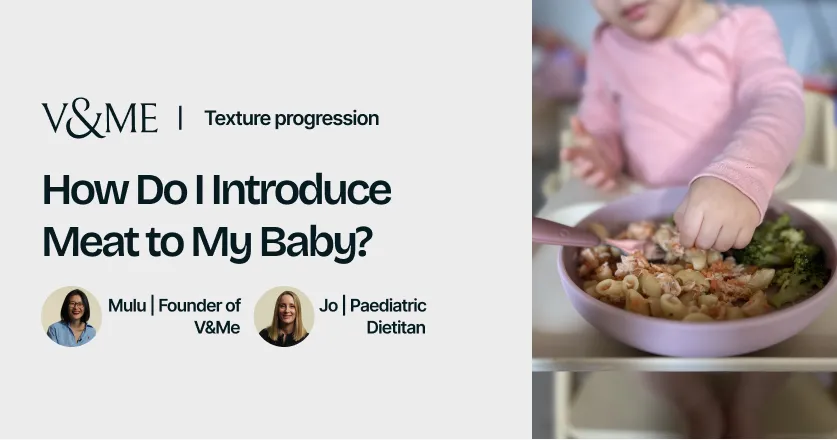
By Jo Lenz, Registered Dietitian (HCPC registered), in conversation with Mulu, founder of V&Me · Published July 2026
Meat can be introduced from six months, right from the start of weaning, and red meat in particular is a really good source of iron at an age when your baby's iron stores are running low. The trick is texture: meat that has been braised or casseroled for a long time is a lot softer and can be mixed with a sauce, which is an easier texture for a baby to manage than something like steak. This question comes up constantly in V&Me's parent chats, so registered dietitian Jo Lenz answered it in full in conversation with founder Mulu, who admits she once resorted to hiding minced meat in blueberries to get it eaten.
When can babies have meat?
From six months, right from the start of weaning. That is the advice. The reason to get on with it is iron: babies' iron stores are running low by this age, so you need to be providing iron rich food from the start, either meat or plant based forms of iron. Families who are more plant based are fine too, it is just about making sure enough iron and those other nutrients come from different types of food. If your family does offer meat, different meats provide different nutrients, so variety matters here as everywhere.
Why is meat texture so hard for babies?
Because meat can be chewy depending on how it is cooked, and the texture can be very dense. Something that seems soft to an adult can be genuinely hard work for a baby. That is why the question comes up so often, and why some babies flatly refuse the texture even when they will eat everything else.
Free texture progression guide download
A simple guide designed by Jo Lenz, ready to be printed and stuck to the fridge.
How should I cook and serve it?
How you cook meat changes its texture. Jo's guidance from the conversation:
- Braise or casserole. Meat cooked for a long time this way is a lot softer, and you can mix it with a sauce, which makes it an easier texture for a baby to manage.
- Soft meatballs. For beef, a soft meatball around five centimetres in diameter is a nice way of introducing it.
- Mash it down. You can mash meat and mix it with something like mashed potato so it is easy for your baby to scoop.
- Shape matters for everything. Even steak is not off the table, it is about the shape of the meat you are offering and serving it in a way that reduces any risk of choking. Jo recommends resources like Solid Starts for clear stage by stage suggestions on introducing different meats.
One more principle from the conversation: think about how your family eats meat anyway. We do not want to be cooking things that are wildly different from what we are having normally, so look at your own family meals and how you can make them work for your baby. That is the whole direction of texture progression: towards the family plate. More on that end goal here.
What if my baby refuses the texture?
Keep offering, without pressure, again and again. Refusing a food once, or refusing its texture, is not a reason to stop offering it. Repeated exposure over the week is how acceptance builds, and remember that touching and tasting already counts. If you are unsure whether it is the taste or the texture being refused, we cover how to tell the difference here.
Meat, cooked the slow way
This is how our kitchen handles it. V&Me meals are cooked fresh every morning in Battersea by chefs working with our dietitians, with meat braised and casseroled to the soft textures Jo describes, and delivered across London the same day. See this week's menu.
FAQs
Q: When can I give my baby meat?
A: From six months, right from the start of weaning. Red meat is a particularly good source of iron at an age when iron stores are running low.
Q: What is the easiest meat texture for a baby?
A: Meat that has been braised or casseroled for a long time, which is much softer and can be mixed with a sauce. A soft meatball around five centimetres in diameter also works well, or meat mashed with potato so it is easy to scoop.
Q: Does my baby need teeth to eat meat?
A: No. Babies manage soft cooked meat using their hard gums, jaw muscles and tongue.
Q: What if my family does not eat meat?
A: That is fine. It is about making sure your baby gets enough iron and other nutrients from plant based sources, with variety across the week.
This article is based on a recorded conversation between Jo Lenz, registered dietitian, and Mulu, founder of V&Me. It is general guidance, not a substitute for individual medical advice. If you are concerned about your baby's feeding, speak to your GP, health visitor or a paediatric dietitian.
Jo Lenz is a registered dietitian with 19 years of experience, including 13 years in the NHS, and has worked with V&Me since it began. V&Me cooks fresh baby and toddler meals every morning in its Battersea kitchen and delivers across London.