Is it OK to give your baby fresh food every day?
Published by Will G · Reviewed by Jo Lenz, Paediatric Dietitian (HCPC registered) · Last reviewed 25th June 2026
Yes. The NHS advice you may have seen ‘not to rely on baby food every day’ is aimed at shelf-stable pouches, pots and jars, not at fresh-cooked food. Fresh meals made and delivered the same day, in varied textures and with no added sugar, sit much closer to home cooking than to a pouch. What matters most is variety, texture progression and your baby joining family meals as they grow and fresh-delivered food supports all three.
If you've read NHS weaning guidance, you'll have seen the advice that shop-bought baby food shouldn't be relied on everyday. That advice is right, and we agree with it. The detail most parents miss is that this is aimed at shelf-stable, long-life products (pouches, pots and jars) on supermarket shelves. Food cooked and delivered fresh the same day is a different thing entirely. This page explains what the guidance actually says, where fresh-delivered meals genuinely differ from a pouch and, honestly, where cooking from scratch still has the edge.
What the NHS actually says, and why
The NHS doesn't object to commercial baby food because it's commercial. It raises specific, sensible concerns about the shelf-stable formats that dominate the market:
- Texture. The NHS notes that most food from pouches and jars has the same soft texture, and wants babies moving on to mashed, lumpy and finger foods as soon as they can manage them, because chewing develops the muscles used for eating and speech.
- Sugar and sweet flavours. Many pouches are fruit-led or sweet-tasting, even ostensibly savoury ones, which can build a preference for sweetness.
- Energy density. Independent reviews of UK commercial baby food have found many products are watery and lower in energy and key nutrients than home-cooked food - so they deliver less per spoonful.
- Sucking from the nozzle. The NHS specifically advises squeezing pouch contents onto a spoon rather than letting a baby suck directly, because sucking raises the risk of tooth decay.
- Learning to eat family food. Mealtimes are where babies learn to self-feed and eat what the family eats.
Why fresh cooking provides textures that a pouch can't
This is the part that matters most and it's where fresh-cooked food and pouches genuinely part ways. Not on marketing but on what each format can physically provide.
A pouch has to squeeze through a nozzle and the contents have to be a uniform purée - there's simply no room for larger pieces of vegetables or meat. Achieving long shelf life means heat-treating the food to keep it safe for that long, which softens and homogenises whatever structure was there to begin with. So a pouch isn't just usually smooth - it's more or less obliged to be!
Frozen baby meals do better than pouches here but it isn't free of trade-offs either. Freezing forms ice crystals that break down the structure of vegetables, so they tend to soften and release water when reheated. You lose some of the bite, and some of the distinctness of real pieces of food.
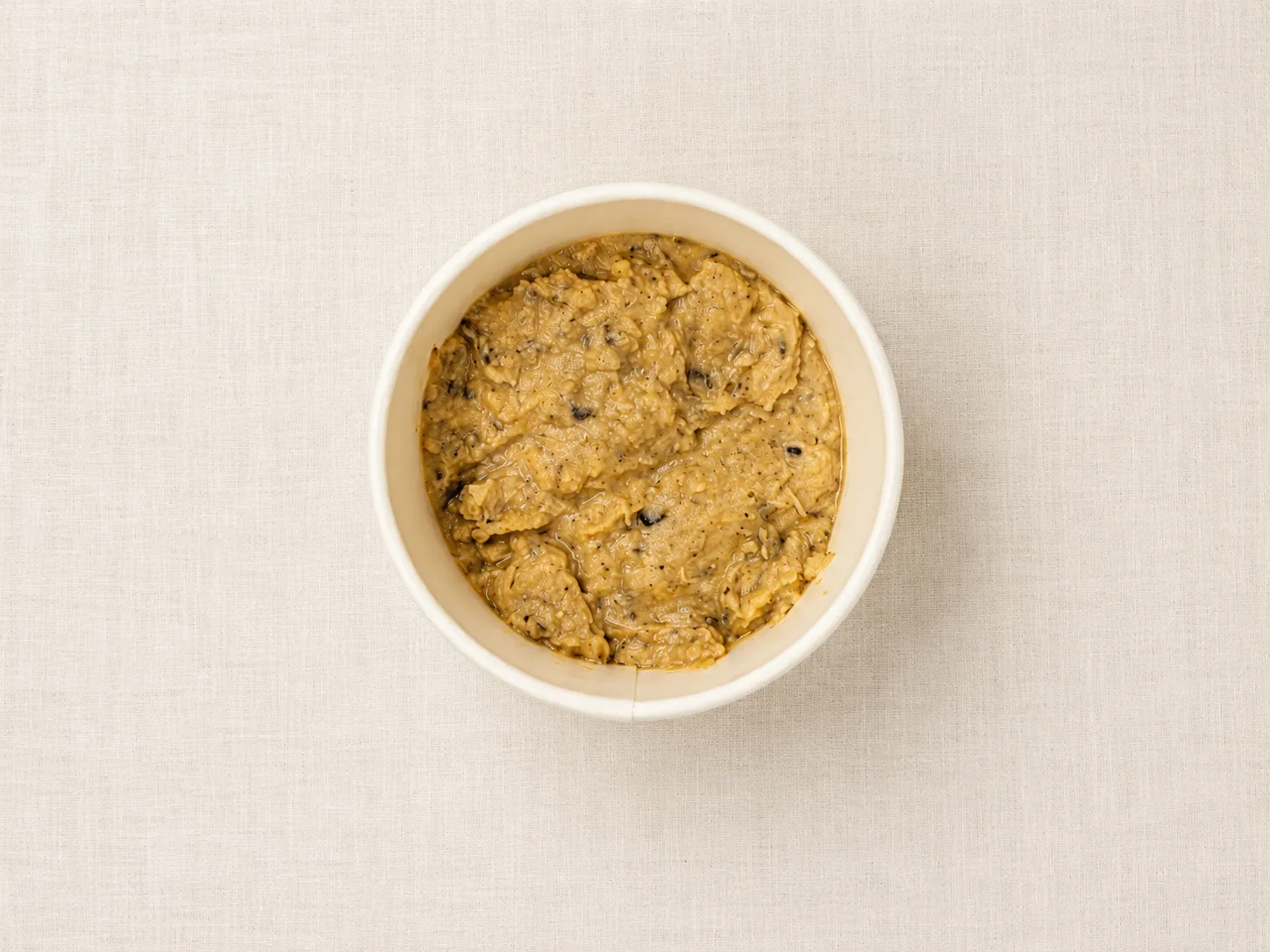
Because we cook fresh, every day, we're not designing around either of those constraints. We cook each vegetable to the right point depending on the dish e.g. soft cooked vegetables, perfect as finger food, proper mashed potatoes rather than blending them into gloopy purée. We build meals into staged textures: smooth, then lumpy, then bite sized so that your baby keeps moving forward instead of staying on smooth purée. The texture they meet on the plate is the texture of the actual food: a real piece of broccoli, a soft-cooked carrot, real meat or fish. Not a version of it blended to fit into a pouch.
That's not a small thing. Learning what real food feels like in the mouth - its bite, its bits, its resistance is part of learning how to eat, exactly as the NHS describes. It's the one thing a fresh kitchen can give every day that a supermarket format structurally can't.
Free texture progression guide download
A simple guide designed by Jo Lenz, ready to be printed and stuck to the fridge.
Where fresh-delivered meals also differ from pouches
On the NHS's other concerns, fresh-cooked food sits closer to home cooking than to a pouch too:
- Savoury and vegetable-led. Our recipes are built around a variety of vegetables and savoury flavours, with no added sugar - ever.
- Not watered down. Meals are cooked to a proper consistency, not diluted or blended to fill a pouch. Proper food from day one.
- Spoon and bowl. Eaten the way the NHS recommends - from a spoon or self-fed - not sucked from a nozzle.
Where cooking from scratch still has the edge
We're not going to pretend a delivery service replaces everything. Two things home cooking does that no delivered meal can:
- The shared experience. Food isn't just for eating. Shopping, prepping and cooking together is a wholesome part of childhood that only families can provide.
- Cost. Cooking from scratch can be cheaper per portion than any delivery service.
So - is it OK every day?
The honest answer follows the NHS line: what matters most is variety, texture progression, and your baby joining family meals and the cooking that surrounds them as they grow. Freshly cooked home delivered meals are the closest commercial option to home cooking, and they're a strong choice for the days you can't cook from scratch - which, for some parents could be most days. Plenty of families combine the two: delivered meals through the week, family food at the weekend. That's not second best. That's a baby getting fresh, varied, properly textured food every day.
FAQs
Q: Is it OK to give my baby fresh baby food every day?
A: Yes. NHS advice about not relying on baby food daily is aimed at shelf-stable pouches, pots and jars – not fresh-cooked food. Fresh meals made and delivered the same day, in varied textures and without added sugar, sit much closer to home cooking. What matters most is variety, texture progression and joining family meals as your baby grows.
Q: Why can't baby food pouches give my baby proper texture?
A: A pouch has to be a smooth purée to pour through its nozzle and the heat-treatment that gives it a long life softens any structure further. Fresh food, cooked daily, can be left as soft pieces, mash or finger foods - so your baby experiences the real texture of vegetables rather than a smooth purée.
Q: What does the NHS say about commercial baby food?
A: The NHS advises that pouches, pots and jars shouldn't be relied on as everyday food, and that babies should move on to mashed, lumpy and finger foods as soon as they can manage them. Its concerns are mainly texture, added sweetness, watery low-energy purées and sucking from pouch nozzles.
Q: Are fresh delivered meals the same as baby food pouches?
A: No. Pouches are shelf-stable, usually smooth, often sweet and designed to be sucked from a nozzle. Fresh-delivered meals are cooked the same day, made in staged textures including lumps and finger foods, savoury and vegetable-led, and eaten from a spoon or self-fed.
Q: Is fresh better than frozen baby food?
A: Both beat shelf-stable pouches on texture, but freezing forms ice crystals that break down vegetables, so they soften and release water when reheated. Fresh food, cooked and eaten the same week, keeps more of the bite and structure of real vegetables. (See our full fresh vs frozen vs pouch comparison.)
Q: Should I still cook for my baby sometimes?
A: Where you can, yes! Shared family meals help babies learn to self-feed and eat what the family eats, and cooking from scratch is cheaper. Many families combine home cooking with fresh-delivered meals for the days they're stretched.
Q: Is delivered baby food healthy?
A: It depends entirely on the food. Fresh meals that are vegetable-led, free from added sugar, properly textured and not watered down meet what weaning guidance asks for. Always check what's actually in the meals rather than judging the format alone.